Maintainers guidelines
The section is dedicated to the DISDRODB core developers (maintainers).
List of the core contributors
Current Release Manager : Ghiggi Gionata
Testing Team : Ghiggi Gionata
Versions guidelines
DISDRODB uses Semantic Versioning. Each release is associated with a git tag of the form X.Y.Z.
Given a version number in the MAJOR.MINOR.PATCH (eg., X.Y.Z) format, here are the differences in these terms:
MAJOR version - make breaking/incompatible API changes
MINOR version - add functionality in a backwards compatible manner. Adding new reader
PATCH version - make backwards compatible bug fixes
Breaking vs. non-breaking changes
Since disdrodb is used by a broad ecosystem of both API consumers and implementers, it needs a strict definition of what changes are “non-breaking” and are therefore allowed in MINOR and PATCH releases.
In the DISDRODB spec, a breaking change is any change that requires either consumers or implementers to modify their code for it to continue to function correctly.
Examples of breaking changes include:
Renaming a DISDRODB product variable or metadata key.
Changing the output format/structure of DISDRODB netCDF product.
Adding new functionalities to the DISDRODB that affect the behavior of the software directly.
Examples of non-breaking changes include :
Fix a bug.
Adding the configuration files to process a new sensor.
Adding a new DISDRODB L0 reader.
Adding new functionalities to the DISDRODB API that don’t affect the behavior of the API directly.
Updating the documentation.
Internal function refactoring that doesn’t affect the behavior of the software directly.
One implication of this policy is that clients should be prepared to ignore the presence of unexpected fields in responses and unexpected values for enums. This is necessary to preserve compatibility between PATCH versions within the same MINOR version range, since optional fields and enum values can be added as non-breaking changes.
Ongoing version support
DISDRODB major releases aims to move the community forward, focusing on specifications stabilization and major feature additions, rather than backwards-compatibility. DISDRODB minor releases will be backwards compatible. We strongly recommend adopting the latest release of DISDRODB into production within 6 months for major releases, and 4 months for minor releases.
The LTE does not guarantee any period of support or maintenance. Recommended versions are supported and maintained by the LTE and our community – we provide updated guidance and documentation, track issues, and provide bug fixes and critical updates in the form of hotfixes for these versions. Releases that are 2 years or older may be considered as deprecated.
Refer to the list of Recommended Releases to see current releases and more details.
Documentation pipeline
DISDRODB’s documentation is built using Sphinx. All documentation lives in the docs/ directory of the project repository.
Manual documentation creation
After editing the source files there the documentation can be generated locally:
sphinx-build -b html source build
The output of the previous command should be checked for warnings and errors. If the code is changed (new functions or classes) then the disdrodb documentation files should be regenerated before running the above command:
sphinx-apidoc -f -o source/api .. ../setup.py
Automatic (Github) documentation creation
One webhook is defined in the repository to trigger the publication process to readthedoc.io.
This webhook is linked to the DISDRODB core developper XXX.
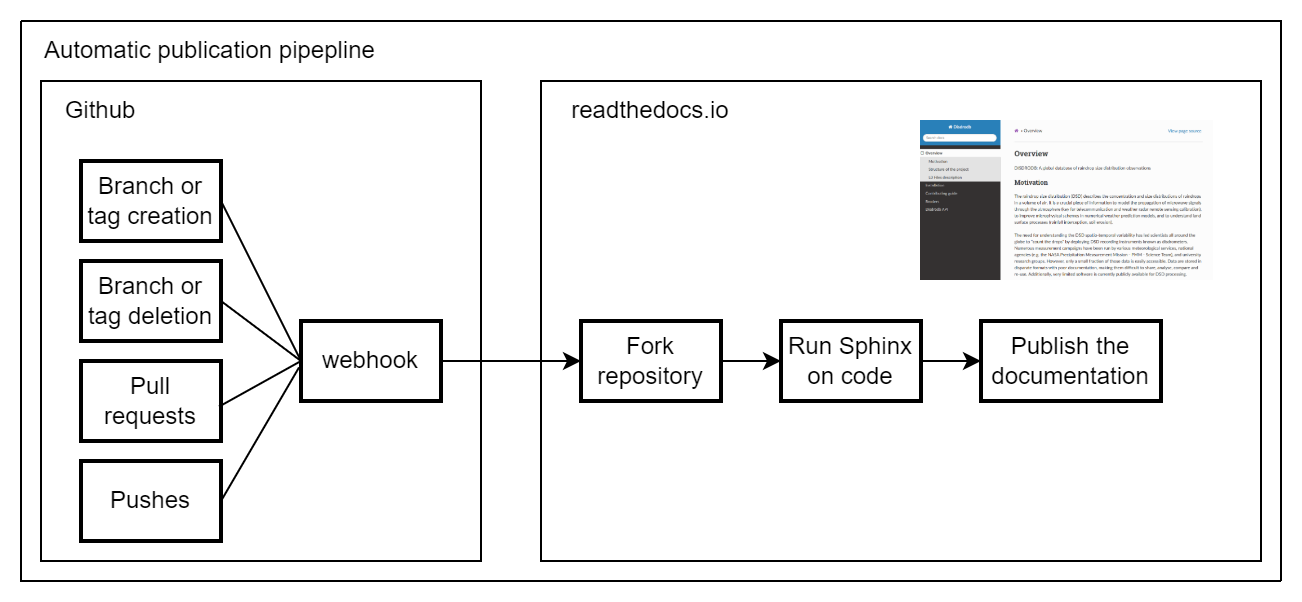
Ghiggi Gionata owns the ReadTheDoc account.
Package releases pipeline
One GitHub Action is defined to trigger the packaging and the upload on pypi.org.
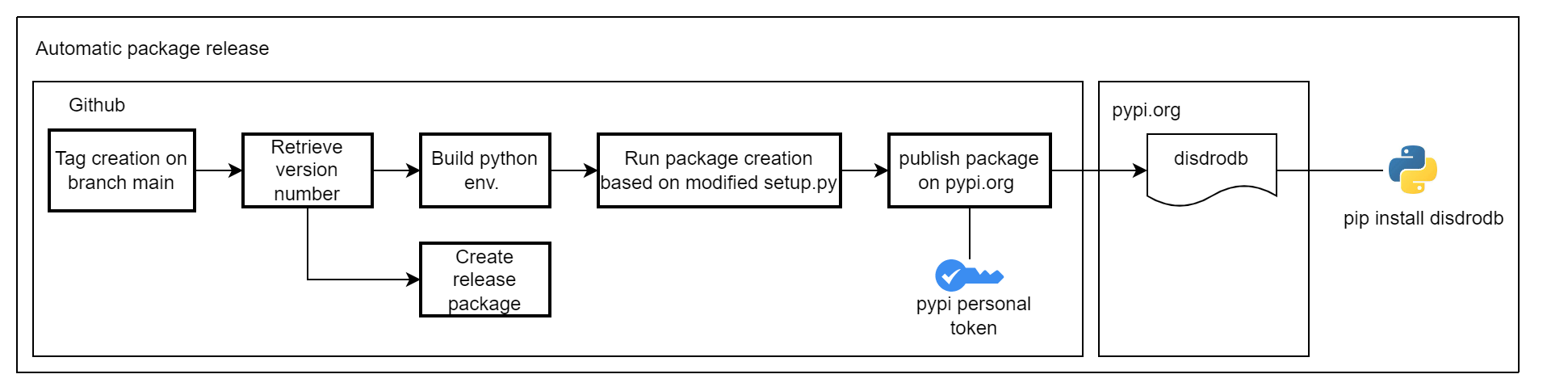
The PyPi project is shared beween the core contributors.
Reviewing process
To do : define test process
Testing processes
Currently, on each Pull Request, GitHub Actions are configured to: * Test that the code complies with the black style format. * Test that the code complies with the ruff linter rules. * Check that the introduced changes does not break the disdrodb software (on multiple OS and environments). * Run tools that checks the code quality and the unit tests coverage (using i.e. Coveralls, CodeFactor <https://www.codefactor.io/>, CodeBeat, …)